A Coffee Jug looks like a simple vessel, yet its design affects heat retention, pouring control, cleaning, and daily service. Demand for coffee continues to create opportunities across the beverage supply chain. The International Coffee Organization’s Coffee Report and Outlook (2023/24) estimated global coffee consumption at 177 million 60-kilogram bags. That figure signals a large coffee market, but it does not directly measure jug sales. Product demand still depends on local habits, buyer requirements, and price.
China offers buyers a broad manufacturing base, from stainless-steel vacuum jugs to glass servers and insulated carafes. But a polished catalog tells only part of the story. Buyers should compare material specifications, lid fit, leak resistance, thermal performance, production capacity, and sample consistency. Ask for test records and relevant food-contact documentation, then confirm that the documents match the exact model being purchased. Small details matter. A lid that drips onto a café counter can undermine an otherwise excellent product.
This guide examines leading Chinese Coffee Jug manufacturers through practical sourcing criteria, not claims alone. It considers product range, customization, quality control, export experience, and communication. Factory visits or independent inspections can add useful evidence, though they may not reveal every production risk. That uncertainty is worth acknowledging. A supplier can look convincing online and still require careful verification. The strongest shortlist is built on comparable samples, clear specifications, and responsive answers—not attractive photos alone.
Understanding China's Coffee Jug Manufacturing Industry
China’s coffee jug manufacturing industry sits between glassware, metalworking, and the fast-changing café supply chain. The USDA Foreign Agricultural Service’s 2024 China Coffee Annual estimates domestic coffee consumption at about 6.3 million 60-kilogram bags for 2023/24. Project Café China 2024, published by World Coffee Portal, counted 49,691 branded coffee-shop outlets. These figures indicate demand, not jug production: public reports rarely separate coffee jugs from broader tableware output.
Factories commonly make glass servers and stainless-steel jugs, with buyers specifying capacity, handle shape, pouring angle, and packaging. A narrow spout can reduce drips; a poorly finished rim can make cleaning harder. Small details matter. For export orders, useful checks include material certificates, capacity consistency, leak tests, and samples tested with hot water. Glass clarity alone is not enough.
China’s manufacturing strength is its supplier network: components, finishing, printing, and cartons can often be sourced nearby. Yet low quoted prices may hide thin walls, uneven welds, or weak inspection records. Buyers should compare drawings, sample results, and production tolerances—not just catalog photos. There is a gap here: market-growth data cannot prove that every factory has skilled jug-making experience. A factory audit and a repeat-order sample offer more grounded evidence than a sales claim.
Common Types of Coffee Jugs Made in China
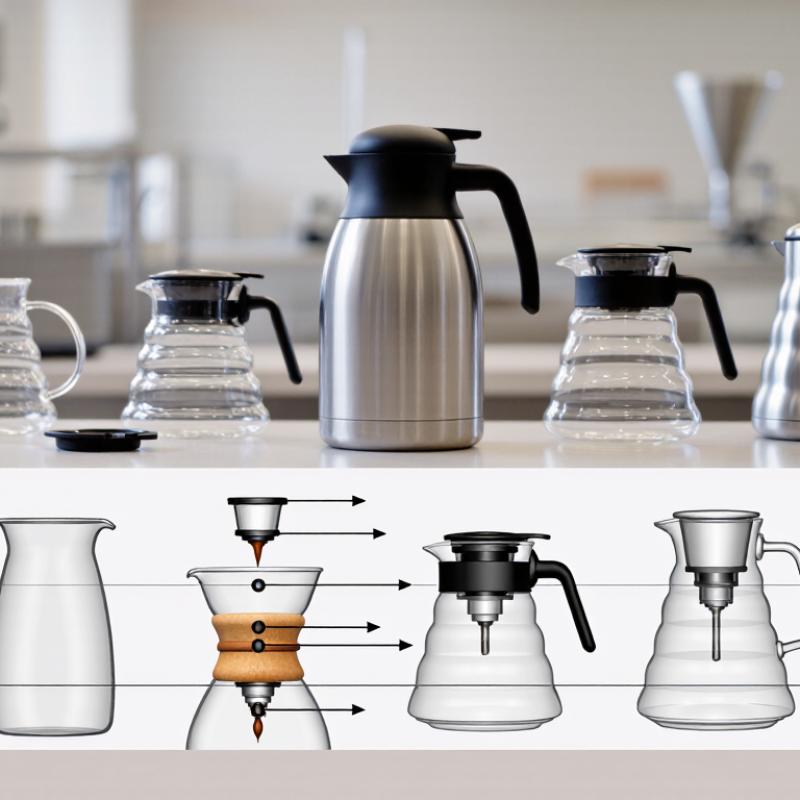
Common coffee jugs made in China include glass carafes, insulated stainless-steel servers, ceramic pots, and barista milk pitchers. Borosilicate glass carafes let users watch coffee drip and suit pour-over brewers. Their thin walls, however, can feel fragile in busy cafés. Double-wall stainless-steel jugs hold heat longer and handle frequent service. Some use vacuum insulation; others rely on a simple inner lining. Ceramic servers offer a heavier, tactile feel, while stainless-steel milk pitchers have narrow spouts for controlled pouring. Small details matter.
Capacity, lid design, and cleaning access often matter more than appearance. The International Coffee Organization’s 2024 market reporting put global coffee consumption at about 177 million 60-kilogram bags in 2023/24. That figure describes coffee demand, not jug sales, but it helps explain why cafés need servers for different brewing volumes. A 300-milliliter glass carafe works for a single pour-over; a larger insulated jug is more practical for a breakfast counter. Buyers should check heat retention claims, handle clearance, and whether the lid comes apart for washing. I would not treat one material as best for every setting: glass shows the brew clearly, but it asks for gentler handling.
Who Are the Top Coffee Jug Manufacturers in China? - Common Types of Coffee Jugs Made in China
| Common Coffee Jug Type |
Typical Materials |
Common Capacity |
Heat Retention |
Typical Use |
Common Product Features |
| Stainless Steel Vacuum Carafe |
Double-wall stainless steel body; plastic or stainless steel lid components |
Approximately 0.6–2.0 L |
Designed to keep coffee hot longer than an uninsulated jug; performance varies by construction and use. |
Home, office, buffet, and table service |
Insulated body, pouring spout, screw-on or push-button lid, and handle |
| Glass Coffee Server |
Borosilicate or other heat-resistant glass, often with a plastic or glass handle |
Approximately 0.3–1.0 L |
Generally uninsulated, so coffee cools more quickly than in a vacuum carafe. |
Pour-over brewing, drip coffee machines, and serving small groups |
Transparent body, pouring spout, measurement markings on some models, and a wide opening for cleaning |
| Pump Airpot Coffee Server |
Stainless steel or plastic outer housing with a vacuum-insulated liner |
Approximately 1.9–3.0 L |
Vacuum-insulated designs help maintain beverage temperature during extended service. |
Meetings, catering, self-service stations, and other high-volume settings |
Top-mounted pump, carry handle, wide base, and a dispensing spout |
| Ceramic Coffee Pot |
Glazed ceramic or porcelain |
Approximately 0.4–1.0 L |
Usually uninsulated; the thick walls may slow temperature change but do not provide vacuum insulation. |
Table service and home use |
Pouring spout, fitted lid, and a glazed surface available in a range of finishes |
| Insulated Plastic Coffee Server |
Food-contact plastic, sometimes with a stainless steel liner or insulating layer |
Approximately 1.0–2.0 L |
Depends on whether the model uses a single wall, double wall, or vacuum-insulated liner. |
Office kitchens, cafeterias, and everyday beverage service |
Lightweight body, insulated handle, push-button or flip-top lid, and drip-resistant spout designs |
Capacities and construction details are typical examples; specifications, materials, and temperature performance vary by product model.
Who Are the Leading Coffee Jug Manufacturers in China?
Who Are the Leading Coffee Jug Manufacturers in China?
Leading coffee jug manufacturers in China are best judged by production capability, not catalog size. Look for factories that control stainless-steel forming, vacuum insulation, lid assembly, and final leak testing. These steps affect heat retention and daily reliability. Ask whether the supplier can provide material specifications and test records for the exact model you plan to order. Details matter.
A capable manufacturer should explain how it checks pouring performance, handle strength, and temperature retention. Request samples and test them with hot water over several hours. Check for drips around the spout, loose lids, and handles that feel awkward when the jug is full. Manufacturing clusters in eastern and southern China offer access to metalworking and packaging suppliers, but location alone does not prove quality.
Communication is part of the evaluation. Clear drawings, confirmed tolerances, and written inspection criteria reduce surprises during production. A polished catalog can still hide inconsistent finishes between batches. That is worth remembering. Smaller suppliers may offer flexible customization, while larger factories may provide steadier capacity; neither is automatically the better choice. Compare sample quality, production lead time, defect handling, and export experience before selecting a partner.
Who Are the Leading Coffee Jug Manufacturers in China?
Material benchmarks relevant to coffee jug design
Thermal conductivity is shown in watts per meter-kelvin (W/m·K); lower values indicate less heat conduction through the material itself. These approximate room-temperature values describe common materials, not individual manufacturers or finished jug performance. Insulation also depends on construction, such as a vacuum layer, and values vary by grade and temperature.
How Chinese Coffee Jug Manufacturers Differ
Chinese coffee jug manufacturers differ in engineering depth, not just price or production volume.
World Stainless reported that China produced about 36.7 million tonnes of crude stainless steel in 2023, from 58.4 million tonnes worldwide. This shows strong upstream capacity, but it does not prove that any jug is well made. Buyers should compare steel-grade documentation, wall thickness, weld quality, and lid fit.
Factories also vary in what they customize. Some focus on large, repeatable orders; others handle smaller runs, unusual spouts, or specific handle shapes. The International Coffee Organization estimated global coffee consumption at 177 million 60-kilogram bags in 2023/24. That signals a broad coffee market, not a direct measure of jug demand. Ask suppliers for batch inspection records and relevant food-contact test reports. A polished sample can still hide inconsistent production. Details matter.
Tips: Test a sample with hot water. Check pouring control, heat retention, lid leakage, and the handle’s comfort after repeated use. Ask whether the approved sample matches routine production. This is easy to overlook.
What to Consider When Choosing a Manufacturer
A coffee jug can appear simple, but its daily performance depends on small manufacturing choices. When comparing manufacturers in China, ask what materials are used for the body, liner, handle, and lid. Stainless steel, glass, and plastic each behave differently under heat and repeated use. Request material specifications, not just a product photo. Small details matter.
Ask for a pre-production sample and test it with hot water. Check whether the handle stays comfortable, the lid closes securely, and the spout pours without dripping. Measure how much liquid the jug holds; printed capacity markings can be inaccurate. A polished sample is useful, but it does not prove every production batch will match. That distinction is easy to overlook.
Discuss quality checks, order quantities, lead times, packaging, and how defects are handled. Request written inspection criteria, such as checks for leaks, surface damage, and lid fit. If available, review relevant test reports and confirm what products and materials they cover. Not always a perfect picture. Clear answers matter more than confident promises. A responsive manufacturer should explain limits as well as capabilities, though communication alone cannot replace sample testing. Before placing a large order, agree on specifications and keep an approved sample for comparison.
Conclusion
China’s coffee jug manufacturing industry serves a wide range of needs, from everyday home brewing to cafés and commercial food service. Manufacturers produce different styles, including insulated jugs that help retain heat, glass models for visibility, and stainless-steel options valued for durability and easy maintenance. Their products can vary in capacity, design, materials, customization, production scale, and quality-control practices, so there is no single type of supplier that suits every buyer.
When comparing potential manufacturers, consider the intended use of the Coffee Jug, required capacity, material preferences, finish, and any customization needs. It is also useful to assess production capabilities, sample quality, communication, lead times, order flexibility, and consistency between samples and bulk orders. A careful comparison of these factors can help buyers identify a manufacturer whose products and service match their requirements and budget.
 Imler
