Imler
China’s coffee equipment market includes factories, trading companies, and specialized suppliers serving buyers across different regions. For importers, choosing a Coffee Bean Dispenser supplier is not just a price comparison. Hopper capacity, portion accuracy, cleaning access, and compatibility with the intended counter setup all matter. In a busy café, a dispenser that is difficult to refill can slow service; inconsistent portions can also affect daily cost control. Small details count.
Supplier claims deserve careful checking. Product photos may look similar, yet construction, dispensing mechanisms, and quality-control routines can differ. Ask for clear specifications, material information, operating instructions, and evidence that sample units match production models. If equipment will contact coffee beans, confirm that relevant materials and documentation meet the requirements of your destination market. Do not assume every supplier uses the same testing process.
This guide explores how global buyers can assess China-based suppliers, compare product options, and prepare practical questions before placing an order. It also considers customization, packaging, communication, and after-sales support, which are easy to overlook when quotations arrive quickly. A low price can be useful, but it is not proof of long-term value. And specifications alone are not enough. Buyers should verify details directly, test samples where practical, and record agreed requirements in writing. Some comparisons will remain imperfect; supplier information is not always presented in the same format. A careful, documented process helps make the decision more reliable.
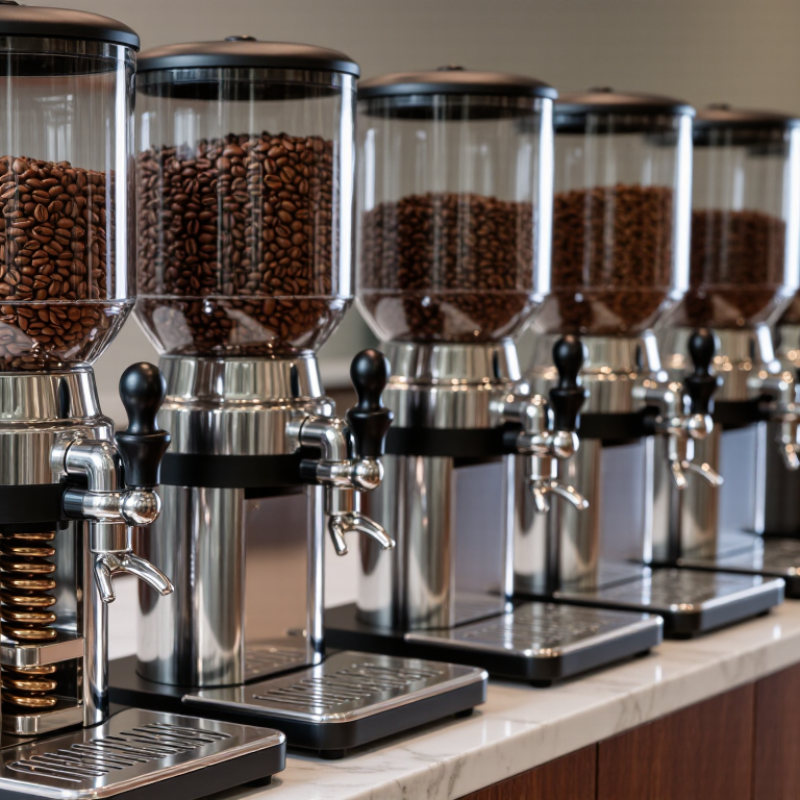
A coffee bean dispenser stores whole beans and releases them in measured amounts for grinding or brewing. In a café, it can reduce repeated scooping and help staff keep portions consistent during busy periods. Some models use gravity: beans move from a hopper through a gate when a lever is pressed. Others use a dial or timed mechanism to control each dose.
The basic parts are easy to recognize. A clear or opaque hopper holds the beans, while a chute directs them into a cup or grinder. With a manual dispenser, the operator opens a small gate and watches the portion fall. In an automated unit, a sensor or motor may stop the flow after a preset amount. Convenient, but not magic. Bean size and roast can affect how smoothly beans move, so a setting that works for one batch may need adjustment for another.
For reliable portions, place the dispenser on a stable counter and check its output with a scale during setup. If a nominal 18-gram dose varies, inspect the gate, bean flow, and calibration before changing the grinder. Coffee oils and broken fragments can collect around moving parts, especially after frequent use. Clean the hopper and chute according to the equipment instructions, and let parts dry fully before refilling. One detail is easy to overlook: a nearly empty hopper may feed less evenly. Regular checks help catch that.
China-based suppliers offer several coffee bean dispenser types for cafés, roasters, and retail counters. Gravity-fed countertop models release beans through a lower chute and suit quick, frequent serving. Airtight canisters use lids or seals to limit exposure to air and moisture. They work well where freshness matters more than rapid dispensing. Simple designs are easier to clean, but the outlet can clog if beans are oily or unevenly sized.
Manual portion-control dispensers use a lever or measured chamber to release a repeatable quantity. Electronic models add buttons or weighing functions, though they need power and careful calibration. For higher-volume use, larger hopper dispensers hold more beans and reduce refilling. Check hopper capacity, food-contact materials, lid fit, and whether parts can be removed for cleaning. A polished sample is useful, but it does not prove consistent performance across production batches.
Tips: Ask suppliers for capacity and dispensing tests using beans similar to yours. Check how the unit handles dark, oily beans, and request clear cleaning instructions. Compare sample dimensions with your counter space. Small details matter. A dispenser may look efficient yet leave beans trapped near the outlet; that is easy to overlook.
Comparing Chinese coffee bean dispenser suppliers takes more than checking unit prices. The International Coffee Organization’s Coffee Report and Outlook estimated global coffee consumption at about 177 million 60-kilogram bags in 2023/24. That demand makes consistent dosing and dependable refills important in busy cafés. Still, market growth cannot prove that a particular dispenser performs well.
Grand View Research valued the global coffee machine market at about US$11.5 billion in 2023, with projected annual growth of 6.8% through 2030. Its market covers more than bean dispensers, so treat it as context, not a direct sales forecast. When comparing suppliers, request hopper capacity, dosing accuracy, food-contact material declarations, and test results. Ask how settings hold up with different roast sizes and oily beans. Small details matter.
A useful check is to run the same beans through sample units and weigh repeated doses. Record variation, residue around the outlet, and how easily staff can clean the hopper. Request quality-system documents, spare-parts lead times, and clear warranty terms. Test it. A polished brochure can still hide inconsistent output, and a single sample cannot represent every production batch. Compare written specifications against physical tests before placing a large order.
Reliable coffee bean dispensers start with consistent manufacturing, not just an attractive sample. Suppliers should explain how they form the hopper, fit the outlet, and control gaps around moving parts. Food-contact materials need clear specifications and supporting test documents. Details matter. A poorly aligned gate can crush beans or leave residue behind.
Customization may cover capacity, outlet size, portion settings, surface finish, and packaging. Share the intended bean size and daily use before approving a design. A compact café counter and a busy self-service area may need different hopper volumes and dispensing mechanisms. Small parts count. Ask for drawings and a physical sample, then check whether it pours evenly and can be cleaned without awkward tools. Custom tooling can improve fit, but it may extend lead times and raise order costs.
Quality control should continue beyond the first sample. Buyers can request inspection records for dimensions, material checks, dispensing consistency, and repeated operating cycles. Suppliers should also describe how they handle defects and keep production batches traceable. A polished sample alone proves little. Cycle testing is more useful, though it still cannot predict every condition in the field. Before shipment, confirm carton protection and inspect a production-unit sample when practical. These checks take time, but they can reveal problems while adjustments are still manageable.
Manufacturing, customization, and quality control—coffee bean sizing is one practical consideration when designing dispensing and handling equipment.
The chart shows nominal sieve aperture sizes for screens 14–18, converted from sixty-fourths of an inch to millimeters and rounded to two decimals. Sieve size describes the opening, not the dimensions of every bean.
For global buyers, sourcing a coffee bean dispenser starts with clear operating details. Specify hopper capacity, counter space, dosing method, and expected daily use. Ask suppliers for dimensioned drawings, material information, and photos of internal components. A sample can reveal details a catalog misses, such as a lid that catches or a lever that feels loose. We have learned that a neat quotation can still leave spare-part costs unclear.
Shipping needs practical planning. Confirm carton dimensions, gross weight, pallet requirements, and the planned shipping term before approving production. Request protective packing around transparent hoppers and moving parts; a loose component can suffer damage during a long journey. Check that the commercial invoice and packing list match the order, and verify destination-specific import requirements with your customs agent. Transit estimates are not guarantees.
After-sales support matters once the dispenser is in daily use. Agree on a contact method, response hours, and a process for sharing photos or short videos of faults. Ask which wear parts can be replaced locally and how to order them. Keep a record of model details and maintenance instructions. Even good plans miss things. A supplier’s willingness to discuss a small recurring issue can say more than a polished sales presentation.
Buyer’s guide: The information below describes common product and sourcing considerations, not verified details for any individual supplier. Specifications, minimum order quantities, lead times, shipping schedules, and warranty terms vary; confirm them in a written quotation and sales contract.
| Product or Sourcing Area | Options and Planning Information | What Global Buyers Should Confirm |
|---|---|---|
| Dispenser format | Gravity-fed countertop dispensers, wall-mounted units, and multi-compartment dispensers are common formats for displaying and dispensing whole coffee beans. | Ask for overall dimensions, compartment count, dispensing mechanism details, and photos or videos of the actual production model. |
| Capacity and layout | Capacity depends on the number and size of hoppers. Request capacity in litres and, where available, a weight estimate for the intended bean type. | Check whether stated capacity is usable capacity or the hopper’s full volume. Confirm the footprint, counter clearance, and refill access. |
| Materials and food-contact parts | Products may combine transparent plastic or glass hoppers with stainless-steel, coated-metal, or other structural components. Material selection affects weight, visibility, cleaning, and durability. | Request the material and grade for each food-contact component, cleaning instructions, and applicable test reports or declarations. Verify that documents match the quoted model. |
| Customization | Possible options include hopper configuration, product dimensions, color, finish, packaging, and buyer-supplied artwork. Custom tooling or finishes can affect cost and schedule. | Obtain drawings, color references, sample-approval requirements, tooling charges, and written confirmation of who owns any custom tooling or artwork. |
| Samples and order quantity | Sample availability and minimum order quantity are supplier- and product-specific; customized versions may have different requirements from standard models. | Ask for sample pricing, sample lead time, production MOQ, and whether sample charges can be credited against a later order. |
| Production schedule | Production timing depends on stock status, order size, customization, component availability, and factory workload. A quoted schedule is not a shipping or delivery guarantee. | Request a production timeline with key milestones, inspection dates, and a clear definition of when the lead time begins. |
| Quality control | Inspection can cover dimensions, appearance, dispensing operation, assembly, packaging, and order quantity. Inspection arrangements should be agreed before production is completed. | Define acceptance criteria, sampling or inspection scope, defect handling, and whether an independent pre-shipment inspection is permitted. |
| Export packaging | Packaging may use individual protective wrapping, cartons, and export packing suited to the product’s material and transport method. | Confirm carton dimensions and gross weight, protective measures for fragile parts, pallet requirements, shipping marks, and packaging photos before dispatch. |
| Shipping and Incoterms® | Commonly discussed arrangements include EXW, FOB, and CIF for sea freight, as well as courier or air freight for samples and smaller shipments. Transit time and cost depend on route, season, carrier, and customs clearance. | Specify the named place or port and the agreed Incoterms® rule and version. Confirm who handles export clearance, freight, insurance, import duties, and final delivery. |
| Export and compliance documents | Commercial shipments commonly require documents such as a commercial invoice, packing list, and transport document. Additional requirements depend on destination, product construction, and import rules. | Ask the buyer’s customs broker or local authority which documents, product declarations, labeling, or tests are required in the destination market. Do not assume a certificate applies to every model. |
| After-sales support | Support arrangements may include spare-part supply, troubleshooting, replacement parts, or warranty service; coverage and duration are set by the supplier’s written terms. | Get the warranty period, exclusions, claim process, response channel, spare-parts availability, and responsibility for replacement shipping in writing. |
| Payment and order protection | Payment schedules and accepted methods vary by supplier and transaction. Terms should be tied to a clearly identified product specification and order document. | Verify the contracting entity and beneficiary details independently. Use a written purchase order or sales contract stating specifications, quantity, price, delivery terms, inspection, and remedies for non-conformity. |
Practical sourcing tip: Compare quotations on the same specification, quantity, packaging, inspection scope, Incoterms® rule, and destination. This makes supplier offers easier to evaluate and reduces misunderstandings about total landed cost and after-sales obligations.
Check hopper capacity, dosing accuracy, food-contact material declarations, and test results. Ask how settings handle different roast sizes and oily beans.
Run the same beans through a sample unit and weigh repeated doses. Record variation and residue near the outlet. Test it.
No. Market figures provide context, not proof of product performance. Physical tests and written specifications offer more useful evidence.
Request dimensioned drawings, internal-component photos, material information, and hopper capacity. Check whether the lid catches or the lever feels loose.
Confirm carton dimensions, gross weight, pallet requirements, and the planned shipping term. Protect transparent hoppers and moving parts. Transit times can slip.
Compare the commercial invoice and packing list with the order. Verify destination-specific import requirements with a customs agent.
Set a contact method, response hours, and a process for sharing fault photos or short videos. Ask about locally replaceable wear parts.
Review quality-system documents, spare-parts lead times, and written warranty terms. A polished quote may still leave costs unclear.
No. A sample reveals useful details, but it cannot represent every batch. Staff habits can also affect test results. Small details matter.
A Coffee Bean Dispenser stores whole beans and releases a measured amount when needed, helping cafés, retailers, and food-service businesses keep portions consistent and workflows organized. Chinese suppliers may offer countertop, wall-mounted, gravity-fed, and automated models, with differences in capacity, dispensing accuracy, materials, and ease of cleaning. Comparing suppliers involves reviewing product specifications, production capabilities, customization options, quality-control procedures, communication, and sample availability.
Buyers can also discuss custom capacities, colors, materials, labeling, and packaging to suit their operational needs. Before placing an order, clarify inspection standards, production timelines, shipping terms, and protective packaging. Reliable after-sales support may include operating guidance, replacement parts, and assistance with maintenance. By assessing both the dispenser’s practical features and the supplier’s manufacturing and service capabilities, global buyers can make informed sourcing decisions and choose equipment suited to their business requirements.
